
A Palestinian Coriolanus
On Hazem Shammas in Bell Shakespeare's production + 47Soul
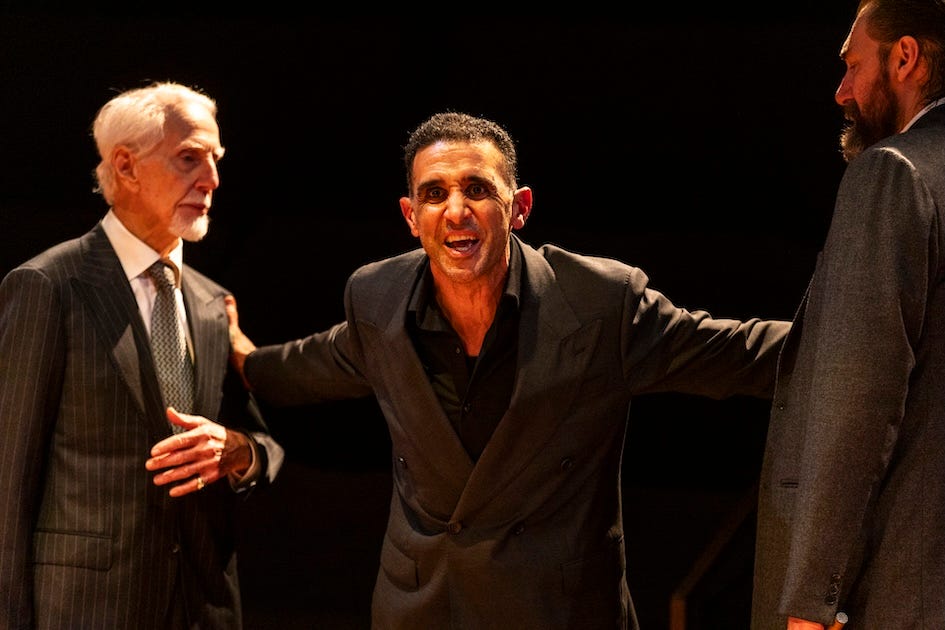
Anger’s my meat. I sup upon myself
And so shall starve with feeding. (Coriolanus, 4.2.68-9)
Nothing in the publicity or programme for Bell Shakespeare’s Coriolanus (1605-8) tells us the actor playing the title role is Palestinian. Nor need there be. Hazem Shammas is an experienced, award-winning actor who carried the title role in Bell’s Macbeth two years ago. Coriolanus is a distinctly challenging role, and Shammas performs it compellingly.
Raised by an ambitious mother in the 5th Century BCE as a fearless warrior who aligns himself with the governing Patricians against the Plebian mass, Coriolanus is uncomfortable with the adulation of either. After routing the Volscians at Corioles, he runs for Roman Consul, but refuses to pander to the crowds whose assent he needs, ultimately inviting banishment over compromise. He allies with the Volscians and marches on Rome, but at his mother’s pleading, halts the attack. Returning to Corioles, he spins a win, but is murdered as a traitor.
More than many of Shakespeare’s title characters, whenever Coriolanus is not on stage, he is the topic of conversation. The actor playing him must embody not only his internal complexity, but meet audience expectations raised by friends and foes alike. “Make you a sword of me?” he asks of the soldiers he leads into battle (1.6.95). In speech and action Shammas carves through the play bright and sharp as a blade.
And yet this is not colour-blind casting. In the production, the difference he brings to Coriolanus is pronounced. In public, he has spoken forthrightly on what the play means to him as a Palestinian-Australian. These factors are integral to the meanings the audience is invited to make of what they are watching. In this essay, I explore how.
‘His singularity’
In Josie Rourke’s 2013 Donmar Warehouse production, Tom Hiddleston’s Coriolanus was cut from the same cloth as the other martial characters, just a little more impetuous. If there is a racial reading to Angus Jackson’s 2017 production for the Royal Shakespeare Company, it’s that Sope Dirisu’s Black Coriolanus has learnt the lessons of the predominantly white, buttoned-up Patricians all too well: the tragic irony of his downfall is that he maintains his poise and restrained delivery even as he renders himself serially outcast.
By comparison, Shammas’s Coriolanus emphasises, as one of the Tribunes - the Plebians’ representatives - dismissively puts it, ‘his singularity’ (2.2.319). While the cast is ethnically diverse, no other character looks or sounds like him.
In contrast to the down-at-heel Plebians and in echo of the Patricians, Shammas sports a black suit. But in distinction to most of the latter, whose white shirts, dark ties and shiny Oxfords code Anglo, his Coriolanus wears a double-breasted suit over a black open-necked shirt, and gold-buckled loafers (see image above).
His Arab-Australian accent is not strong, but it is recognisable, and he uses it strategically to emphasise Coriolanus’s combativeness. Deriding the restive Plebians, for example, his accusation that ‘your affections are/ A sick man’s appetite” (1.1.188-9), lands more heavily, like a blow, because the ‘t’ sounds in ‘appetite’ are ‘flapped’ to take on more of a ‘d’ sound. Taunting his arch-enemy Aufidius, leader of the Volscians, the enervating “-er” at the end of “I do hate thee/ Worse than a promise-breaker” (1.8.1-2) is repurposed with bright aggression as “promise-breaka.”
Presentation and delivery carry over into Shammas’s broader inhabitation of the stage. Cominius, Coriolanus’s fellow soldier and outgoing Consul, could be played as equally warlike. He is presented by Gareth Reeves as vanilla to the point of translucence. Similarly, though director Peter Evans describes Aufidius in a programme note as Coriolanus’s ‘mirror character’, here they could hardly be more different. Anthony Taufa’s Aufidius is gangly in person and vaguely drawn in personality. Shammas’ Coriolanus is tautly compact, in definition laser-cut.
This distinctiveness is amplified by Shammas’s unique range of movement. The play is crammed with animal imagery, variously claimed or applied in praise or abuse. But Shammas’s Coriolanus alone inhabits the animal world: going on all fours, covered in blood and stripped to the waist, lashing out when at bay.
These are only the most obvious departures from the postural norms most other characters inhabit. In keeping with Coriolanus’s combination of arrogance and vulnerability, Shammas turns his head to address a character more often than his whole body. His deep-set eyes glitter and deflect, throwing focus onto his broad mouth which, with its lopsided grin, itself signifies more than one thing at a time. He can be full-frontal - he is the only character to kiss others on both cheeks. But when he strides out of the public square through the audience with a magisterial “thus I turn my back” (3.3.164), he renounces the people completely.
In other words, this is a character who seems to exist on – and move through – more planes or axes than those around him, enabling him simultaneously to attract and deflect, assault and defend, embrace and shun. Shammas draws on both expressions and perceptions of who he is to give physical and psychological form to a character who strives to stay true to a complex (but not divided) self, while holding a line between competing parties (the Plebians and the Patricians, his mother and his wife).
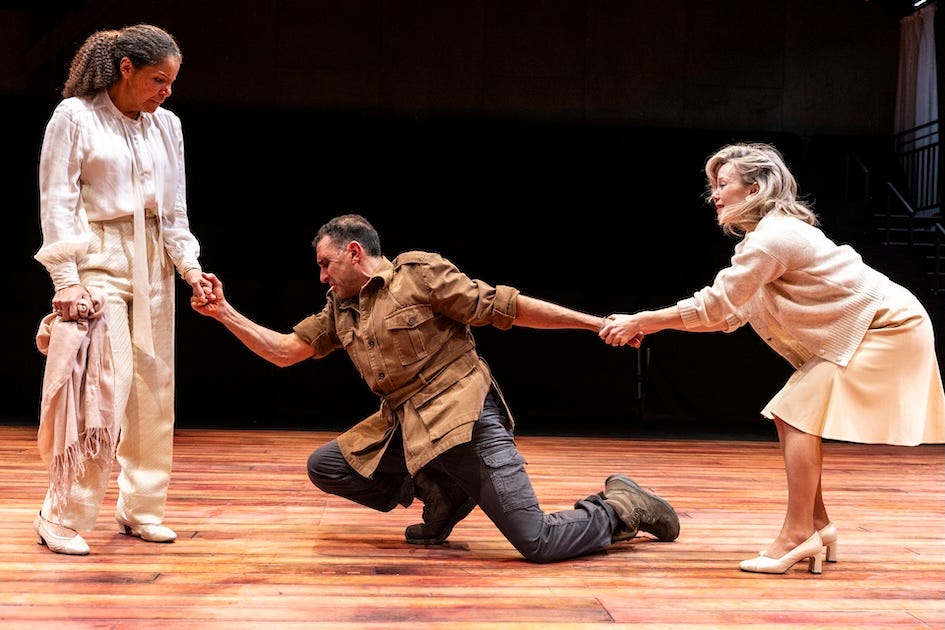
When this becomes untenable, the play ends.
Dabbling in whimsy?
Coriolanus’s singular qualities are by no means reducible to the ethnic and cultural identity of the actor portraying him. But they are charged by it. And given the current circumstances, any interpretive movement beyond the immediate frame of the production is likely to reinforce this feature.
One need not travel far. Although the programme makes no mention of Shammas’s background, in rehearsal shots – as in this publicity video – he wears a keffiyeh-pattern baseball cap.
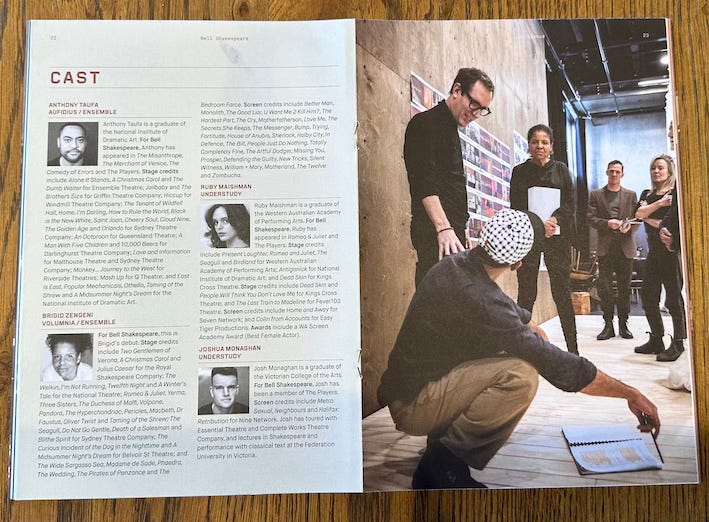
The immediate symbolism – freedom for Palestine – is supplemented by a context-specific statement. In November 2023, Sydney Theatre Company publicly apologised after three actors wore keffiyehs at the opening night curtain call of The Seagull. I don’t think I’m alone in concluding that Shammas appears as he does in the programme to remind Australian theatre-goers that the keffiyeh is not going anywhere.
In publicity appearances, Shammas has expanded on this. In a June profile in The Age, he said of the political machinations of the play:
It makes me sad because we keep telling these stories, and we keep having these rituals together to share these stories, and we don’t seem to learn, or we don’t even see it around us.
By the time of an ABC interview two months later, with the death toll in Gaza continuing to climb and the appalling effects of Israel’s aid blockade and subsequent deadly food distribution system becoming more apparent by the day, Shammas was openly despairing:
Hazem Shammas doesn't see the point in making art at a time like this.
"I feel the futility of it more and more," he tells ABC Arts…
And later:
Making theatre at this time, Shammas says, is "dabbling in whimsy" and an "intellectual privilege".
This is remarkably blunt given he is supposed to be selling the play, and should give any bien-pensant arts enthusiast pause. Set against the extreme violence and suffering in Gaza, Hamas’s intransigence and the Israeli government’s implacable commitment to its war aims, art can only pale to insignificance as a response.
Incontrovertible as it is, however, this fact sits in the article alongside other considerations. Shammas still counts himself an artist: “‘That's who I am; it's what I do,’ he says. ‘That's why I'm so troubled by this.’” And even as he despairs at the political efficacy of art, he is angered by the silencing of artists who have expressed solidarity with Gaza. The result, he says, is:
We're in a perpetual state of fear, and we're walking around not talking about it, only worried about our next job and whether we've got a job or not, while people are being f**king slaughtered.
But of course one way of ‘talking about it’ is by talking about Coriolanus, which Shammas describes as “a play about the abuses of power.”
For Shammas, this includes withering judgment of Coriolanus himself. In the Age profile, he describes the character as a ‘monster’ who deserves no sympathy. In the ABC interview, he says:
I'm a Palestinian, playing a role where the actor walks around talking about wiping people out as a solution.
and:
I'm playing a role where a man walks around talking about essentially ethnic cleansing. Of course I'm going to think about that constantly.
One can only imagine how challenging Shammas must have found rehearsing and performing such a character this year. But there is more to Coriolanus than monster. And just as Shammas’s own identity is inseparable from Coriolanus as presented on stage, so might we hear echoes of Coriolanus in his public statements about the play.
Coriolanus is not interesting because he is murderous, but uncompromising. Large parts of the play involve him being prevailed upon to tell other people what they want to hear: action is driven by the impact of his refusals. As Cominius says, this is a man who “rewards/ His deeds with doing them” (2.2.145-6). Talk is both cheap and false by comparison.
So when, in what’s supposed to be a puff piece for the show, Shammas describes doing theatre now as “dabbling in whimsy”, he is himself pulling a Coriolanus in language strongly redolent of the character’s put-downs of his fellow citizens. When he says of power, politics and Palestine, "[t]here's a conversation to be had, and it should be uncomfortable, and uncomfortable shouldn't necessarily be a threat to anyone," we can’t help but hear those moments in the play when Coriolanus asks the crowd to accept him on his own terms:
FOURTH CITIZEN You have been a scourge to her [Rome’s] enemies;
you have been a rod to her friends. You have
not indeed loved the common people.
CORIOLANUS You should account me the more virtuous
that I have not been common in my love. (2.3.100-4)
Today, this rhetorical strategy has a familiar ring. In public statements and media appearances, Palestinian advocates work consistently to advance their position engaging media interlocutors, and at the same time challenging the terms of the debate.
Take, for example, this Instagram video from Nasser Mashni, President of the Australian Palestine Advocacy Network, following an antisemitic arson attack on the East Melbourne Synagogue in July:
Mashni’s ninety-second statement is seemingly personalised, yet pointedly shot at a site of significant symbolic power. It aggressively turns the tables on those who demand he condemn the Synagogue attack, before reframing the debate and then indeed delivering just such a condemnation. It speaks to multiple addressees (reporters, the arsonist, activists), and is at once uncompromising towards adversaries and radically inclusive in its horizons. It does all this in a carefully modulated tone that builds rhythm, cadence and momentum, using imagery that, alongside more familiar vocabulary, references parts of the body (head, ears), religion (holy sites, Abraham’s children), fighting, disavowal, and love.
During his campaign for Consul, Coriolanus particularly objects to pandering to the crowd by showing his battle scars. This is spun as pride by the Tribunes who are out to discredit him, but for Coriolanus it is also a matter of dignity:
I have some wounds upon me, and they smart
To hear themselves remembered (1.9.33-4).
He will not make a spectacle of the wounds that index violence for those who were not there, and cannot understand it.
I am circumspect about some of Mashni’s arguments. But then persuasion is not the point. He lays out a position on violence for those at a greater distance from it than he and his community. It’s not for him to parade the wounds; it’s for the rest of us to figure out what we’re going to do with what he tells us, and how he chooses to do so.
Empathy in association
Coriolanus features famine, protest, authoritarian rule, militaristic repression, territorial invasion, impassioned debate, betrayal, psychodrama, and murder. Refracted through Hazem Shammas as Coriolanus, none of these elements find simple analogues in the current situation in Israel and Palestine, but all are quickened by it.
The second time I watched the production, the newspaper I had brought to lean my notepad on carried the headline ‘Israel set on conquering Gaza.’
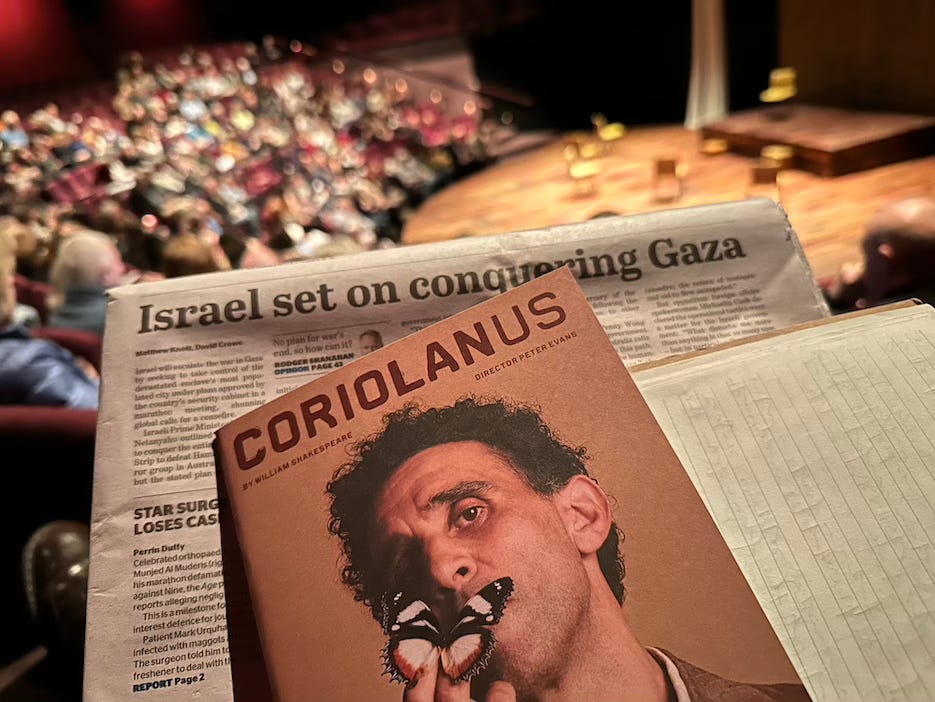
The previous day, the Israeli security cabinet had decided to take control of Gaza city. In Shakespeare’s play, Coriolanus leads his former enemies the Volscians with ruthless success to the gates of Rome, at which point several characters petition him to show mercy on the city. Most powerfully, his mother asks him to broker peace, or else fall foul of what she delivers as a pre-emptive curse:
VOLUMNIA Thou know’st, great son,
The end of war’s uncertain, but this certain,
That, if thou conquer Rome, the benefit
Which thou shalt thereby reap is such a name
Whose repetition will be dogged with curses,
Whose chronicle thus writ: “The man was noble,
But with his last attempt he wiped it out,
Destroyed his country, and his name remains
To th’ ensuing age abhorred” (5.3.162-70).
It was impossible to hear these words ring out from Brigid Zengeni’s indomitable Volumnia in isolation. Audience attention thickened around the moment.
On 3rd August, Jews observed Tisha B’Av, fasting to mark the sacking of Jerusalem by the Romans in 70CE. An Economist article reported that while some Jews hope to see a restored Holy Temple, which was destroyed by the Romans, replace the Muslim Dome of the Rock, others
…lament destruction past and present. ‘Gaza is desolate and laid ruin. We are the new Romans,’ a religious leader with the Faithful Left, a group that has flourished during the war, tells his flock.
Again, the correspondences are pronounced, but inexact. In Coriolanus, Rome is under attack; at the siege of Jerusalem, the Romans were the aggressors with whom some Jews, to their distress, now identify.
The present suffering in Gaza is unconscionable. Immediate action is required to alleviate that suffering, and the threat of the situation worsening is very real. Those with the greatest investment in its outcomes have settled on a narrow, high stakes and relentlessly reiterated vocabulary to variously describe, contest or justify what is happening. In other settings, some of that language is my language too, and Shammas’s despair at theatre’s capacity to meet this moment on these terms is completely understandable.
But if Bell’s Coriolanus has its own power, it lies precisely in multiplying the meanings of this situation in ways that deepen, rather than detract from, our engagement with it. The ‘intellectual privilege’ of making and watching theatre cannot and need not replace other forms of action.
When you have to work to make the connections, and to reconcile the singular experience of a theatrical event with what you know and feel about the world you came in from and return to, understanding changes. There is an empathy to association that has its own granular force and durability.
In Bell’s Coriolanus, what is absolute and what complex about Gaza coexist in the figure of Hazem Shammas. His Coriolanus dies the longest stage death I have seen. There is every potential for comedy. Instead, it is agonising. Stabbed by Aufidius, his breathing becomes shallow, then hollow. He falls forward, then back, legs askew. We are watching him expire. There is an outbreath, and we hold our own in anticipation of its return. Nothing. The blackout descends softly, but completely.
Cue Grams: 47Soul
I saw the Palestinian-Jordanian group 47Soul earlier this year at WOMADdelaide, after they were disinvited from the same festival in 2024 for the most muddled of reasons. On a hot March afternoon, they gave a blistering performance to a large and appreciative crowd.
As diasporic, pan-Arabic pioneers of the ‘Shamstep’ style - a hybrid of electronic music and Arabic folk genres, particularly the dabke wedding form - they have come to particular prominence in the past few years (a recent conversation between group member Tarek Abu Kwaik and leftwing British journalist Owen Jones is here).
For a small-screen analogue of the energy they bring to their live performances, I like this 2019 NPR Tiny Desk Concert. The desk itself not only gets multiple shout-outs in the course of the performance (‘Tiny Desk, where you at?’), but a thorough workout when Walaa Sbait repurposes it as a dance floor.